Beyond the Rust Belt and Sun Belt: How American Investors Are Building Wealth in India's Emerging Urban Corridors
The Domestic Squeeze That's Sending Capital Abroad
For much of the past decade, American real estate investors operated in a forgiving environment — low borrowing costs, steady appreciation, and predictable rental yields made domestic property a reliable wealth-building vehicle. That calculus has shifted considerably. The Federal Reserve's rate-tightening cycle pushed 30-year mortgage rates to multi-decade highs, cap rate compression in gateway markets like New York, Los Angeles, and Miami has made yield-positive acquisitions increasingly elusive, and competition from institutional buyers has priced individual investors out of many once-accessible submarkets.
The result? A meaningful reallocation of attention — and capital — toward international opportunities. India, in particular, has emerged as a preferred destination for US-based investors seeking asymmetric growth potential. And within India, it is the so-called Tier-2 cities — Pune, Hyderabad, Jaipur, Coimbatore, Kochi, and Indore among them — that are generating the most compelling risk-adjusted conversations.
Why Tier-2 Cities, and Why Now?
India's metropolitan giants — Mumbai and Delhi — have long attracted foreign investor attention, but their land markets increasingly mirror the saturation dynamics that US investors are trying to escape. Entry prices are steep, regulatory complexity is high, and the days of double-digit annual appreciation in these markets are largely behind us.
Tier-2 cities tell a fundamentally different story. These urban centers are beneficiaries of a structural demographic shift that has been decades in the making. India's working-age population — projected to remain the world's largest through at least 2050 — is migrating away from congested megacities toward secondary hubs that offer improved quality of life, lower cost of living, and expanding employment ecosystems.
Pune exemplifies this trajectory. Once regarded primarily as a retirement and educational hub, the city has transformed into one of India's most dynamic technology and manufacturing centers. Its proximity to Mumbai, combined with significantly lower land and labor costs, has attracted multinationals including Volkswagen, Infosys, and Cognizant. Residential demand has tracked this corporate migration closely, with land values in growth corridors like Hinjewadi, Wagholi, and Chakan posting consistent annual appreciation in the range of 12 to 18 percent over the past five years.
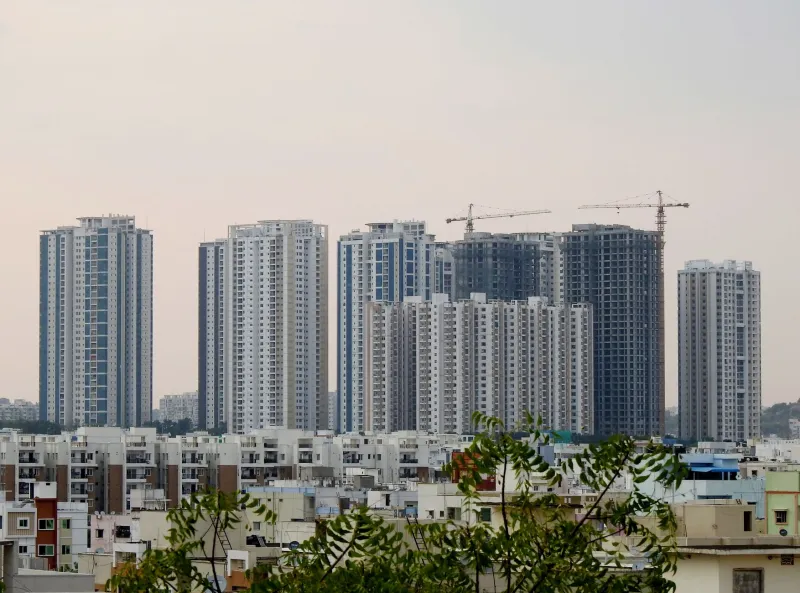
Hyderabad, meanwhile, has earned a reputation as India's most investor-friendly major city — a designation backed by consecutive years of leading national rankings in ease of doing business. The city's HITEC City and Financial District zones have attracted Amazon, Google, and Microsoft campuses, creating an employment density that is driving sustained residential absorption in surrounding areas like Gachibowli, Kokapet, and Shamshabad. For land investors specifically, the Outer Ring Road corridor has delivered some of the most impressive appreciation metrics of any urban market in Asia over the past decade.
Jaipur occupies a distinct but equally compelling niche. As Rajasthan's capital and India's gateway to its most storied heritage tourism circuit, the city is experiencing a convergence of hospitality investment, logistics infrastructure, and an expanding middle-class residential base. The Delhi-Mumbai Industrial Corridor passes through Rajasthan, and Jaipur's positioning along this freight and development axis has meaningfully accelerated industrial land demand in its peripheral zones.
The Currency Equation: A Structural Tailwind for Dollar-Denominated Buyers
One of the most underappreciated advantages available to US investors entering Indian land markets is the structural currency differential between the US dollar and the Indian rupee. Over the past twenty years, the rupee has depreciated against the dollar at an average rate of approximately 3 to 4 percent annually. For an American investor converting dollars into rupees to purchase Indian land, this dynamic creates a compounding advantage: the same dollar amount purchases progressively more rupee-denominated assets over time, and upon eventual liquidation, repatriation of proceeds benefits from favorable conversion.
Consider a practical illustration: an investor who allocated $200,000 to a land parcel in Hyderabad's Outer Ring Road corridor in 2015 would have purchased that asset at an exchange rate of approximately 64 rupees per dollar. At current rates near 83 rupees per dollar, the same parcel's rupee-denominated appreciation translates into an even more favorable dollar return upon exit — effectively layering a currency gain atop the underlying land appreciation.
This is not a risk-free dynamic — currency movements can work in both directions — but for investors with a medium-to-long-term horizon of five years or more, the historical trend has consistently favored dollar-denominated entrants into Indian property markets.
Regulatory Evolution: RERA, FEMA, and the Changing Foreign Investment Landscape
A legitimate concern that has historically tempered US investor enthusiasm for Indian real estate is regulatory complexity. The introduction of the Real Estate Regulatory Authority (RERA) framework in 2016 represented a watershed moment in addressing this concern. RERA mandates project registration, developer accountability, standardized disclosures, and escrow protections for buyer funds — reforms that meaningfully reduced the opacity that once characterized Indian property transactions.
For foreign nationals, the Foreign Exchange Management Act (FEMA) governs property acquisition in India. While non-resident Indians (NRIs) enjoy relatively straightforward access to Indian real estate, foreign nationals of non-Indian origin face more significant restrictions on direct residential and commercial property purchases. However, the land investment landscape for US-based investors of Indian origin — a substantial and affluent demographic — has become considerably more streamlined, with digital documentation requirements, online registration processes, and expanding NRI banking infrastructure reducing the friction that once made cross-border transactions cumbersome.
US investors without Indian origin are increasingly accessing these markets through structured vehicles including real estate investment partnerships, joint development agreements with registered Indian entities, and — as India's regulatory framework continues to evolve — emerging REIT structures that offer indirect exposure to land and commercial property appreciation.
Case Profiles: American Portfolios with Indian Land Exposure
The theoretical case for Indian Tier-2 city investment is reinforced by a growing body of real-world portfolio outcomes. A California-based technology entrepreneur with NRI status allocated approximately $350,000 across three land parcels in Pune's Hinjewadi Phase III corridor between 2017 and 2019. By 2024, independent valuations placed the combined portfolio at a rupee-equivalent of $680,000 — a return that significantly outpaced both the S&P 500 and domestic California real estate over the same period.
A Texas-based physician couple invested $180,000 in a plotted development project near Hyderabad's Shamshabad airport zone in 2018, drawn by the area's proximity to the under-construction Regional Ring Road. The project reached completion, infrastructure development proceeded broadly on schedule, and the parcel's current market value reflects appreciation exceeding 90 percent in dollar terms.
These are not isolated anecdotes. Across the NRI investor community in cities like Fremont, Edison, and Sugar Land — concentrated hubs of Indian-American professional wealth — land investment in India's secondary cities has become a normalized component of diversified portfolio strategy.
Infrastructure as the Defining Variable
What distinguishes the most successful Indian land investments from speculative plays is proximity to committed infrastructure development. India's National Infrastructure Pipeline — a $1.4 trillion program targeting roads, railways, airports, and urban transit through 2030 — has created identifiable corridors where land demand is being structurally driven rather than merely hoped for.
The Pune Metro expansion, Hyderabad's Regional Ring Road, Jaipur Metro Phase II, and the Kochi Water Metro have each generated measurable appreciation in surrounding land parcels as construction has progressed. For investors capable of identifying infrastructure timelines and acquiring land ahead of completion — a strategy that requires local expertise and patient capital — the return profile has historically been exceptional.
At Akshaya Lands, our curated portfolio of land opportunities is specifically selected for proximity to verified infrastructure development, ensuring that our investors benefit from the structural demand drivers rather than speculative narrative.
A Strategic Allocation, Not a Wholesale Pivot
Sophisticated US investors are not abandoning domestic real estate wholesale. Rather, they are recognizing that a diversified portfolio in today's environment benefits from geographic distribution — and that India's Tier-2 cities represent one of the most credible emerging-market land investment opportunities available to dollar-denominated buyers.
The combination of demographic growth, infrastructure investment, currency dynamics, improving regulatory frameworks, and compressed entry prices relative to domestic US alternatives creates a compelling case for meaningful allocation. The investors who recognized this opportunity five years ago are sitting on substantial gains. The question for today's investor is whether the same structural drivers — which have not fundamentally changed — make the current entry point similarly attractive.
The evidence suggests they do.