From the Options Desk to Open Acres: Why Long-Term Land Investment in India Outpaces Short-Term Trading
The Treadmill No One Talks About
There is a particular kind of exhaustion that comes with active trading. Ask any seasoned options trader in the United States and they will describe it in similar terms: the pre-market anxiety, the constant screen monitoring, the emotional whiplash of a single news cycle that can erase weeks of disciplined positioning. The S&P 500 may trend upward over decades, but the path there — for those actively managing short-dated contracts — is anything but smooth.
Yet for years, this treadmill was accepted as the price of participation. If you wanted outsized returns, you accepted outsized volatility. That assumption, however, is being quietly challenged by a cohort of American investors who have discovered an entirely different model: patient capital deployed into Indian land markets, where appreciation compounds not over days or weeks, but over years and decades.
At Akshaya Lands, we have observed this shift firsthand. The name akshaya — drawn from Sanskrit, meaning that which never diminishes — reflects a philosophy that resonates deeply with investors who have grown weary of strategies that demand constant attention and deliver inconsistent results.
The Mathematics of Patience
Consider the structural difference between the two approaches. An options trader in the US operates within a framework defined by time decay, implied volatility, and contract expiration. Even when directionally correct, a trader can lose money simply because the underlying asset did not move fast enough. The instrument itself works against patience.
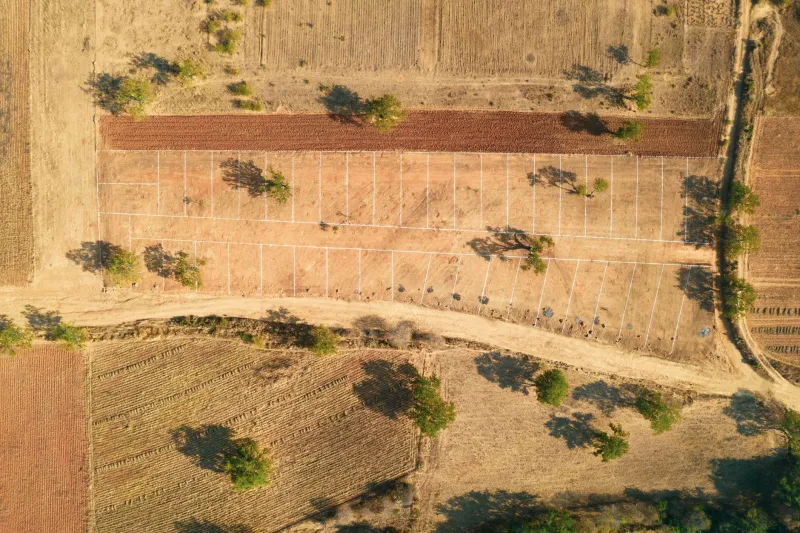
Land ownership in a developing Indian city operates on an entirely different logic. There is no time decay. There is no margin call. The underlying asset — physical, finite, and increasingly scarce in rapidly urbanizing corridors — tends to appreciate as infrastructure arrives, population density increases, and commercial demand follows residential growth.
Investors who purchased residential plots in cities such as Vijayawada, Coimbatore, and Nagpur between 2013 and 2015 have, in many documented cases, seen their land values appreciate by 180% to 340% over 8- to 10-year holding periods. That translates to annualized returns in the range of 12% to 16% — figures that compare favorably with long-run US equity benchmarks, but without the sleepless nights that accompany a leveraged derivatives portfolio.
Tier-2 and Tier-3 Cities: The Real Opportunity
Much of the media coverage of Indian real estate focuses on Mumbai, Delhi, and Bangalore — cities that, while dynamic, already carry valuations that reflect decades of prior appreciation. The more compelling opportunity for new capital lies in India's second- and third-tier urban centers.
These cities — think Indore, Surat, Vizag, Kochi, and Lucknow — are experiencing a convergence of forces that historically precede significant land value appreciation. Central and state government infrastructure investment is accelerating, with highway expansions, new airport terminals, and dedicated freight corridors reshaping connectivity. Corporate decentralization, accelerated by the remote-work normalization of recent years, is bringing employment centers to cities that previously served primarily as regional hubs.
The resulting demand for residential and commercial land is outpacing supply in many of these markets. Investors who position themselves ahead of this curve — before the appreciation becomes widely recognized — are the ones capturing the most meaningful returns.
Repositioning Capital: What the Transition Looks Like
Several American investors who have made this transition share a common narrative arc. The initial catalyst is typically a period of significant loss or exhaustion in active trading — a bad quarter in 2022's volatile rate environment, or a broader reassessment of how much cognitive bandwidth a trading strategy actually consumes.
The pivot to Indian land is rarely impulsive. Most investors spend six to twelve months in research mode, studying market dynamics, legal frameworks for foreign ownership, and the mechanics of repatriation. They consult with advisors familiar with the Foreign Exchange Management Act (FEMA) and the structures through which NRIs and foreign nationals can legally participate in Indian property markets.
Once capital is deployed — typically in tranches, across one or two emerging markets — the experience is, by most accounts, remarkably different from active trading. There are no daily decisions to make. There is no position to defend. The investment thesis plays out over years, not hours, and the primary requirement of the investor is simply patience.
One investor who repositioned approximately $120,000 from an options-heavy brokerage account into two residential land parcels in a tier-2 city in Andhra Pradesh in 2017 reported a combined valuation increase of approximately 210% by 2024 — a holding period return that would have been difficult to replicate through consistent options trading without accepting substantially higher risk.
The Risk Calculus Is Different, Not Absent
It would be misleading to suggest that Indian land investment is without risk. Currency fluctuation between the US dollar and the Indian rupee introduces a variable that equity traders will recognize, even if the dynamics differ. Liquidity is more constrained than in public markets — selling a land parcel takes weeks or months, not seconds. And due diligence requirements, particularly around title clarity and zoning classifications, demand careful attention.
However, the nature of these risks is fundamentally different from the risks embedded in short-term trading. They are, for the most part, manageable through research, proper legal structuring, and the selection of credible development partners. They are not the kind of risks that materialize at 9:31 a.m. on a Tuesday because the Federal Reserve released unexpected language in meeting minutes.
For investors who have spent years managing the latter category of risk, the former often feels like a welcome trade.
Building Wealth the Akshaya Way
The concept of akshaya — wealth that endures, capital that does not diminish — is not merely a brand identity. It reflects a genuine investment philosophy that has historically rewarded those willing to adopt a longer time horizon.
American investors are accustomed to thinking about wealth-building through the lens of equity markets, retirement accounts, and real estate within their own borders. The expansion of that mental framework to include Indian land markets represents, for many, a meaningful diversification — not just of geography, but of investment temperament.
The options trading treadmill will always have its adherents. The speed, the leverage, and the intellectual stimulation of active markets appeal to a certain kind of investor. But for those who have run that race long enough to question whether it is taking them anywhere meaningful, the patient capital model — land in India's fastest-growing cities, held through cycles, appreciated over years — offers a genuinely compelling alternative.
At Akshaya Lands, we exist to help investors navigate that alternative with clarity, confidence, and the kind of informed guidance that long-term wealth-building deserves.