Rupees, Acres, and Resilience: How Indian Land Assets Shield American Wealth From Dollar Erosion

For most American investors, currency risk is something you encounter when trading foreign equities or holding international ETFs. It is rarely discussed in the context of physical land. Yet for those who have quietly acquired plots in India's expanding urban and peri-urban corridors, the currency dimension of that investment has become one of its most compelling attributes — one that traditional financial advisors seldom raise and that mainstream investment media almost never covers.
The dollar's long-term trajectory is not a secret. Decades of expansionary monetary policy, compounded by post-pandemic stimulus, have eroded purchasing power in ways that are now unmistakable at the grocery store, the gas pump, and the real estate closing table. Against this backdrop, owning a hard asset denominated in a different currency — one tied to an economy growing at a structurally higher rate — offers a form of insulation that stocks, bonds, and even domestic real estate cannot fully replicate.
Understanding the Mechanics of Cross-Border Land Appreciation
When an American investor purchases land in India, two distinct value drivers come into play simultaneously. The first is the intrinsic appreciation of the land itself, driven by India's urbanization pace, infrastructure investment, and demographic momentum. The second is the relative movement between the US dollar and the Indian rupee over time.
Historically, the rupee has depreciated gradually against the dollar — a pattern that might initially seem to work against a US-based investor. However, this surface-level reading misses a critical nuance. Land values in India have, in many growth corridors, appreciated at rates that substantially outpace rupee depreciation. When you combine a 12–18% annual land value increase in a well-selected tier-2 or peri-urban market with even a modest currency buffer strategy — such as repatriating proceeds during periods of rupee strength — the net dollar-denominated return can be considerable.
Furthermore, if the dollar weakens against the rupee during a period of India's economic outperformance — as has occurred in intermittent cycles — the American investor benefits doubly: appreciation in rupee terms converts to an even larger dollar gain upon repatriation.
The Inflation Angle That Most Advisors Overlook
Inflation in the United States is fundamentally a dollar phenomenon. When the Federal Reserve expands the money supply, it dilutes the value of every dollar-denominated asset on your balance sheet — your savings account, your bond portfolio, and in real terms, even your domestic property if price growth fails to outpace inflation.
Physical land in India operates outside this mechanism entirely. Its value is set by Indian market forces: local demand, regional infrastructure development, population density trends, and the aspirational purchasing power of India's expanding middle class. None of these variables are directly correlated to decisions made in Washington or on the floor of the New York Stock Exchange.
Consider the experience of Ramesh and Priya Chandrasekaran, Indian-Americans based in the Dallas–Fort Worth metropolitan area, who purchased a 1,200-square-yard residential plot in a developing corridor near Hyderabad in 2017. At the time of acquisition, the investment represented approximately $38,000 USD. By 2023, independent valuations placed the plot's market value at the rupee equivalent of roughly $74,000 — a near-doubling in dollar terms — during a period when their domestic equity portfolio barely kept pace with cumulative US inflation. Their land in India did not fluctuate with the S&P 500. It did not react to interest rate announcements. It simply appreciated, anchored to the physical reality of a city expanding outward.
Tax Implications for US-Based Investors
Owning foreign real estate as a US citizen or permanent resident does carry reporting obligations that investors must approach with care and qualified guidance. Under the Foreign Account Tax Compliance Act (FATCA) and standard IRS requirements, Americans with foreign assets above certain thresholds must file Form 8938 as part of their annual tax return. Foreign real estate held directly — meaning in your name rather than through a foreign entity — is generally not subject to FBAR reporting, though proceeds from a sale that are held in a foreign bank account would be.
Capital gains on the sale of Indian land are subject to taxation in India under the Income Tax Act, with rates varying based on the holding period and the investor's residential classification under Indian law. The US–India tax treaty provides mechanisms to avoid double taxation, allowing investors to credit taxes paid in India against their US tax liability in many scenarios. Working with a cross-border tax professional experienced in both jurisdictions is not optional — it is essential.
That said, the tax framework, while requiring diligence, does not fundamentally undermine the investment case. Properly structured, the after-tax returns from Indian land in high-growth markets have historically remained competitive with — and in many documented cases superior to — comparable domestic alternatives.
Why Physical Land Outperforms Financial Proxies
Some investors attempt to gain exposure to India's growth story through ADRs, India-focused mutual funds, or emerging market ETFs. These instruments have their place, but they are not currency hedges in any meaningful sense. When you own shares of an Indian company listed on a US exchange, your asset is still priced in dollars. The underlying currency exposure is often hedged away by the fund manager, and you remain subject to the same systemic risks that affect all dollar-denominated securities.
Physical land, by contrast, cannot be margin-called. It cannot be delisted. It does not have an expense ratio. It sits on the ground, and its value is determined by the people and businesses that want to occupy that ground. In a country where urbanization is adding the equivalent of a new Chicago to its population every few years, that demand is not speculative — it is structural.
For American investors who have watched their purchasing power quietly diminish through years of low interest rates and quantitative easing, the appeal of an asset class that simply exists — that occupies physical space in one of the world's fastest-growing economies — is becoming increasingly difficult to dismiss.
Building a Currency-Diversified Portfolio With Indian Land
The most prudent approach is not to abandon dollar-denominated assets entirely but to allocate a meaningful portion of one's investable net worth to hard assets in economies with different monetary trajectories. Financial planners who specialize in global wealth management increasingly recommend a 10–20% allocation to non-dollar real assets for high-net-worth individuals concerned about long-term dollar devaluation.
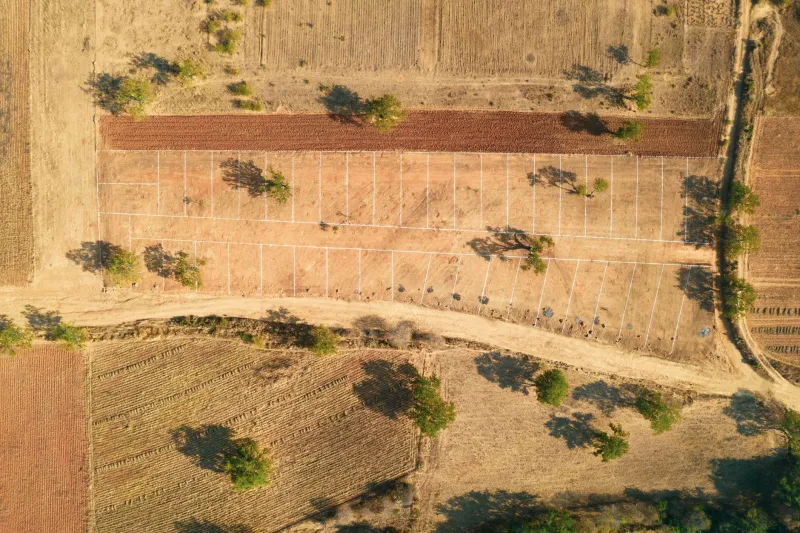
India's land markets — particularly in growth corridors around cities like Hyderabad, Pune, Bengaluru's peripheral zones, and emerging tier-2 centers — offer entry points at valuations that remain accessible by American standards while delivering appreciation curves that domestic markets have not seen in a generation.
At Akshaya Lands, our mandate is to connect investors with verified, legally clear land opportunities in India's most compelling growth markets. The name itself — Akshaya, meaning inexhaustible or ever-growing in Sanskrit — reflects the enduring nature of land as a wealth-building vehicle. For American investors navigating an uncertain dollar environment, that philosophy has never been more relevant.
The currency hedge nobody talks about is already working for those who found it early. The question is whether you will recognize the opportunity before the conversation becomes mainstream.